Ancient trees
Ancient trees
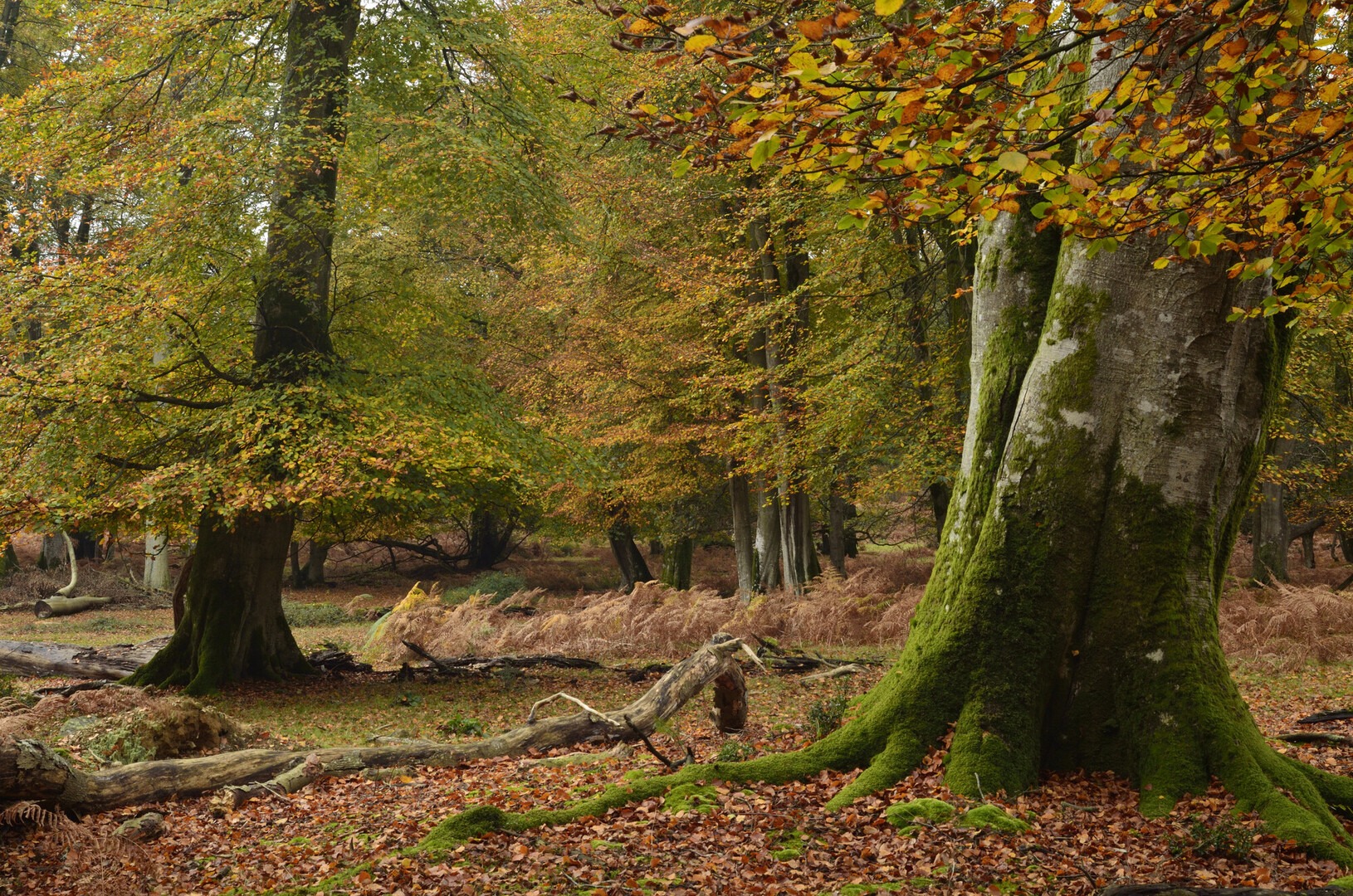
The New Forest is of exceptional importance for ancient and veteran trees. It has a greater concentration than anywhere else in western Europe – more than 1,400 have been recorded here so far!
Immensely old, and full of character and charisma, ancient trees are rare. They have been sculpted by time and revered by generations of local people.
They are great survivors, and have lived through remarkable changes in the world around them. Many were fully grown trees when the Roundheads and Cavaliers were fighting the English Civil War or even when Elizabeth I defeated the Spanish Armada.
What are ancient and veteran trees?
Ancient oaks may be 400 to 800 years old, while beech can reach 300 to 400 years. The most ancient of all are yews, some of which are thought to be over 1,000 years old. Typically, the oldest trees have a great girth, a hollow trunk and a much-reduced crown.
Veteran trees will be the next generation of ancients. They are slightly younger in age, often still with a full crown, but clearly showing signs of age such as damaged branches or dieback.
Ancient trees are home to a whole host of wildlife. Their twisted bark, hollows and dead wood provide a multitude of specialist habitats, including nest sites for birds like the redstart.
The New Forest is one of the most important areas in Britain and Europe for lichens, beetles, bats and fungi dependent on very old trees, including many rare and threatened species.
The Knightwood Oak, Knightwood Inclosure – an ancient pollard
The Knightwood Oak is perhaps the most famous New Forest tree. Also known as ‘The Queen of the Forest’, this huge oak with majestic spreading limbs is a good example of an ancient ‘pollard’.
Pollarding is the practice of regularly cutting branches above the height that grazing animals can reach, thereby preventing damage to the new shoots and the eventual loss of the tree. In the New Forest this was carried out mainly to provide leafy fodder for the deer: the boughs cut were not meant to be bigger than a deer could turn with its antlers.
In practice, Forest officials often abused these rules and cut larger branches for firewood or building materials. Some were duly fined for doing so. Pollarding helps to rejuvenate a tree and allows it to live far longer than a nonpollarded tree or ‘maiden’. It produces the distinctive shape of many of the oldest trees in the Forest, with the main limbs all arising from the same point two to three metres from the ground. The trunk often develops thicker growth beneath the branches to support their weight.
The Eagle Oak, Knightwood Inclosure
This fine pollarded oak with a girth of 5.4m is now hidden away in the Knightwood Inclosure, with a yew tree growing through it. It has the dubious distinction of being the tree where, in 1810, a New Forest Keeper is said to have shot the last of the New Forest’s white-tailed eagles.
The Gritnam Oak, Gritnam Wood – a shipbuilding survivor
The supply of timber for shipbuilding was an important industry in the Forest from the Middle Ages until the Napoleonic Wars. Most was used to build warships at Southampton, Portsmouth, and later at Bucklers Hard near Beaulieu.
Relatively small amounts of timber were taken until the early 1600s. However the Stuart monarchs, and later Cromwell, embarked on a major overhaul of navy ships and from 1625 to 1685, about 3,000 tons of timber was felled and transported from the Forest each year. In 1608 a survey of the New Forest found almost 124,000 trees fit for navy timber, while by 1707 the figure had declined to less than 12,500.
Mature oaks, about 150 years old, were in the greatest demand. Oak timber is very durable and the crooks formed by the spreading branches of naturally grown (maiden) trees were used for the large curved structural timbers of the ship. Beech was used on a smaller scale, mainly for the decks, walls and other internal work. As a consequence relatively few trees in the Forest survive from before the 1630s and naturally grown ancient oaks – like the great oak at Gritnam – are particularly rare. Following the most intensive period of fellings a new generation of trees developed between about 1660 and 1760. These are now 250 to 350 years old and are the veteran trees to be found throughout the Forest today.
The Park Hill Beech, Lyndhurst – a wealth of wildlife
The Park Hill beech is hidden away near the medieval boundary bank of Lyndhurst Old Park. It has the strangely contorted, sculptural form of many ancient pollards. The gnarled trunk, crevices, dead wood, holes and hollows create a myriad of wildlife habitats.
Every ancient tree provides an ecosystem in its own right. Amongst the more obvious species associated with old trees in the New Forest are birds like the redstart, lesser-spotted woodpecker and treecreeper. They make use of holes and loose bark for nest sites and feed on the many woodland insects. At least 13 of the 18 British species of bats are found in the Forest, including the rare Bechstein’s and barbastelle bats, both of which have important populations here.
The continuity of generations of ancient and veteran trees in close proximity makes the New Forest particularly important for woodland lichens and beetles. The Ancient and Ornamental woodlands have the richest lichen flora in lowland western Europe. These curious associations of algae and fungi require clean air and humid conditions, and many are restricted to ancient trees. Some of the woods, such as Mark Ash, just south of Bolderwood, hold more than 250 different species, and the New Forest is home to several species that have so far been recorded nowhere else.
The St Nicholas Yew, Brockenhurst – tree myths and traditions
Ancient Druidic myths and beliefs associate the yew tree with death and rebirth. Encouraged to grow near places of worship, yew branches and foliage were cut for ceremonial occasions. Many of our oldest specimens, like the St Nicholas Yew, are found still thriving in churchyards today.
The link with death probably arose because the yew’s leaves and seeds are poisonous to people, yet the tree itself can live for thousands of years and can regenerate when a low branch touches the ground, sprouts roots and grows into a new tree.
As yew trees grow old, their central core rots away, making them difficult to age, but a yew tree with a girth of 6m is likely to be at least 1,000 years old.
Other ancients of the New Forest
Some of the oldest of the Forest’s trees are coppiced holly. These trees have been cut (or possibly browsed by animals) near ground level in the past and then allowed to re-grow. Over time these new stems spread outwards, all connected by the same root system.
Some coppiced hollies are found within the Ancient and Ornamental woodlands, but others remain as isolated trees on the open heath. They have become characteristic features of the Forest landscape; the many-stemmed tree at Mogshade is a good example.
The oldest single-stemmed holly so far dated was from 1709, but the largest coppiced trees are estimated to be at least 400 years old.
The New Forest contains important areas of alder ‘carr’ woodland, a habitat which is rare in both Britain and Europe. It is found along stream sides where the water table is high and the peat soils have been enriched by nutrients. Most of the alder woodland has been coppiced over many years.
In relatively recent times alder timber was used to produce fine charcoal for the Schultz Gunpowder Mill near Fritham (from about 1860) and for gas mask filters in World War II. The oldest coppiced alders are 4m to 6m in circumference and may date from the 16th century or earlier.
Crab apples are not usually thought of as ancient trees, but in the New Forest there is a large population scattered along woodland edges, and in glades and clearings.
Many are recent colonisers and perhaps some are ‘wilding’ apples originating from discarded cores, but occasionally native trees can reach a substantial size and age. The largest are estimated to date from between 1660 and 1760.
‘It is no exaggerated praise to call a tree the grandest, most beautiful of all the productions of the earth.’
This quote is by William Gilpin, an 18th-century naturalist and artist who was vicar of Boldre and whose influential work ‘Remarks on Forest Scenery’ emphasised the importance of trees in landscape art and their role in the natural world.