Heathland birds
Heathland birds
With some of the largest areas of heath in Europe, the New Forest is particularly important for heathland birds.
Heathland is good for these and other birds because of its open nature with scattered bushes and few trees, its warm and dry habitat and the abundance of insects.
It is estimated that in the UK about 70% of heathland has been lost over the last 100 years and as a result the birds that depend on this habitat have become increasingly rare.
In the New Forest the heathland is managed by the grazing animals which keep the heather in check and prevent trees and scrub invading. Controlled burning also plays an important role in maintaining heath.
Here we look at the rare heathland bird species and some of the more common ones that you are likely to see. When you are out walking on the heathland between March and July, please keep on the main tracks to reduce disturbance to nesting birds.
Guides to Heathland Birds
Ground Nesting Birds
Download Guide Download GuideHeathland Highlights
Download Guide Download GuideDartford warbler
The Dartford warbler is a true heathland specialty and the New Forest is one of its strongholds.
In the rest of the UK it is only found in the southern counties and Suffolk. These are the only places that stay warm enough for the species to survive through the winter and also have suitable heathland habitat.
In the New Forest, Dartford Warblers can be found on areas of open heathland with a scattering of gorse bushes. This is the only habitat where you are likely to find them, except in winter when you may see them in gorse scrub along the coast.
Most warblers spend the winter in Africa, but Dartford Warblers stay here all year round. They survive because the heather and gorse are thick and evergreen and they can find insects among the bushes throughout the winter, even when there is a covering of snow. But harsh winter weather will kill many of them and after the 1960s just a few pairs survived in the country. More recently their numbers increased due to warmer winters and well managed areas of heathland.
The best way to look for Dartford Warblers is to go to an area of heathland with gorse bushes on a sunny morning in April or May when the males will be singing on top of the gorse bushes. Areas such as Dur Hill near Burley and Hampton Ridge, near Frogham, are good places.
Males look colourful in books with a crimson underside and steel grey upperparts. However the best way to recognize Dartford warblers is that they are the only tiny, grey bird of heathlands with a long tail.
Hobby
The New Forest is a stronghold for hobbies in Hampshire, and the heathlands and wet river valleys of southern England are where the majority of hobbies occur. They are widespread but uncommon in most of England and are mostly absent from Wales and Scotland.
Hobbies prefer to hunt over open, damp ground, especially in spring because their favoured food at that time of year is dragonflies. They are not common in the New Forest and you could see one almost anywhere within or around the National Park. The damp heaths are the most regular hunting ground for them.
Hobbies are summer visitors to the UK, arriving from Africa in May and heading south again in September or October. They are very fast and agile flyers – so much so that they can catch swallows and swifts in flight.
There are no guaranteed places to see a hobby, but your best chance would be to walk slowly around the damp heaths near Beaulieu Road Station in the early evening in May or early June. Hobbies sometimes gather here and several can be seen at the same time on occasions.
Hobbies are a bird of prey that look like a huge swift with long scythe-like wings and a fairly short tail. They differ from kestrels in having a dark grey back and from peregrines by having longer and more slender wings.
Meadow and Tree Pipit
Pipits are amongst the commonest birds on the heathlands of the New Forest. The meadow pipit is common throughout Hampshire and the UK, while the tree pipit is just as widespread but not as common.
Meadow pipits breed on any treeless, open ground, such as heathland, downland and short grassland and they can be found all over the New Forest and surrounding area. Tree pipits are more choosy. They prefer open ground with scattered trees and bushes. Young plantations and heathland with a few trees suit them well, but this is a scarcer habitat and so the tree pipit is less common.
Both pipits have a wonderful display flight. They fly up while calling and then glide back down on parachute- like wings as they deliver a series of descending notes. Meadow pipits tend to start and finish from the ground, while tree pipits start and finish from a tree or bush.
You can easily find meadow pipits anywhere on the open heath at any time of year. Tree pipits are summer visitors. Look for them in heathy areas with scattered trees or open parts of pine plantations from April through to July.
The meadow pipit is also the main host species for cuckoos breeding in heathland areas of the New Forest.
With their brown backs and speckled breasts, pipits resemble thrushes, but they are smaller (about the size of a sparrow) and have thinner beaks. Meadow pipits and tree pipits are very similar: the best way to tell them apart is the habitat they are found in and their song flight. Visually the tree pipit has far fewer black streaks along the flanks than the meadow pipit.
Nightjar
In the UK the nightjar population is local and scattered, and these unusual birds are found in areas of heath and young woodland. The New Forest is a particular stronghold; nightjars are scarce in the rest of Hampshire.
Nightjars prefer open country with few scattered trees, such as heathland and young forestry plantations. In the New Forest they are widespread over such areas.
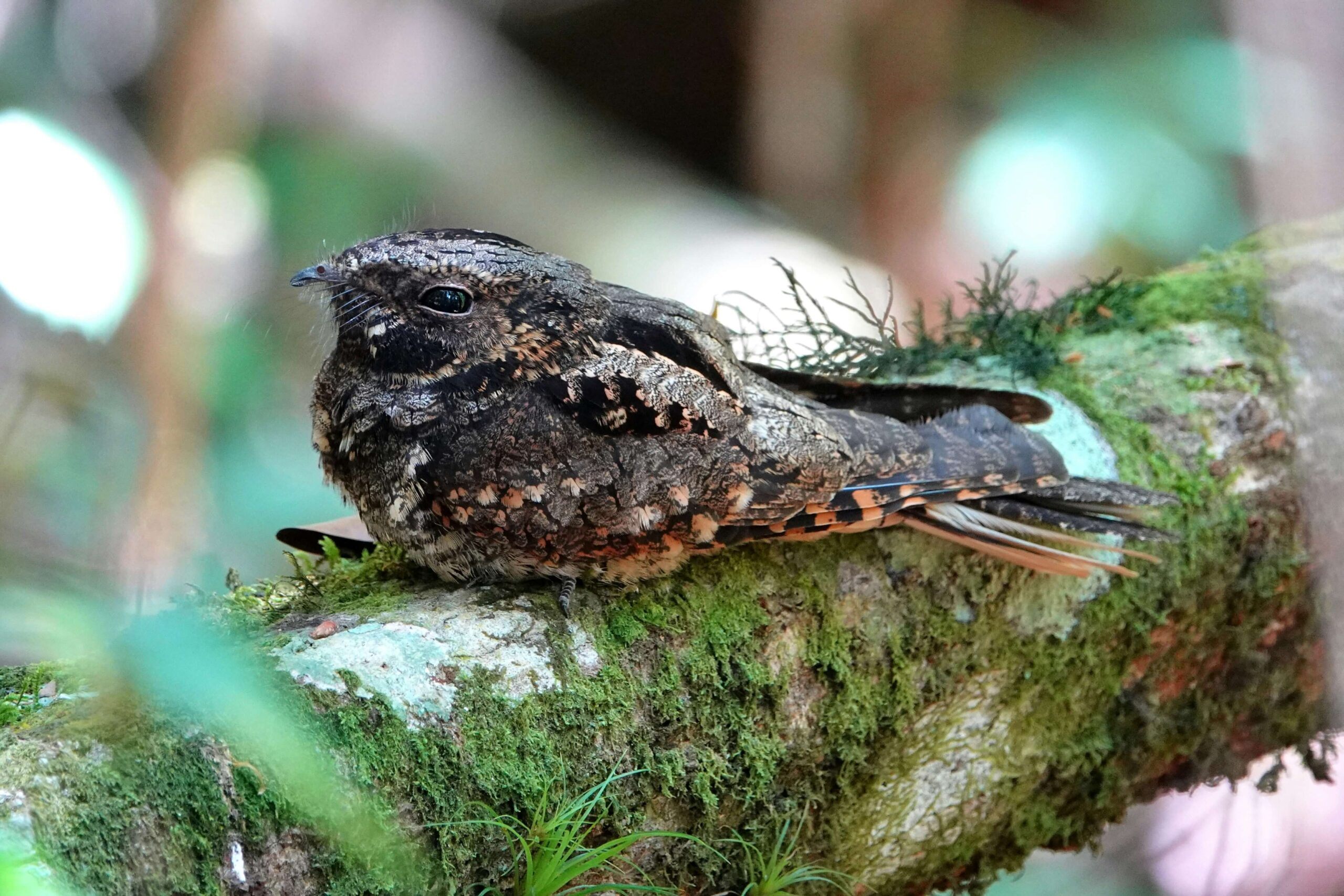
Nightjars are a wonderful and enigmatic bird and people will not forget seeing, or hearing, one. They are only active at night as they feed on moths and other insects caught on the wing. They also sing at night – an eerie but beautiful churring sound, given from a prominent perch in a tree on the heath. They have a silent floating flight, but the males will clap their wings together in a display to attract females. They are summer visitors (from Africa) and you will only see them between mid-May and August.
Being nocturnal, they rest during the day. They also nest on the ground and so are superbly camouflaged with mottled browns and greys that are almost impossible to see against the background of bracken, heather and gravels.
To see (or more like hear) nightjars, go out onto the open heaths such as Beaulieu Road Heath or the areas around Burley during the early evening in summer and wait to hear their churring song. (For safety please do not go alone and do take a torch.) June and July are the best months.
Nightjars are very hawk-like in flight with long, pointed wings and a long tail. Males have a white spot on each wing that can sometimes be seen, but the shape and song along with their nocturnal activity make them unmistakable.
Stonechat
This is a fairly common species in Hampshire and the whole of the UK. In the south it is more common on heathlands: there are more breeding in the New Forest than anywhere else in Hampshire.
Stonechats will breed in any open rough country with scattered bushes for nesting. As well as heathland, they breed on the chalk downs and along the coast in scrubby grassland. Maintaining a good mosaic of scrub, grassland and heathland in the New Forest is important for the stonechat.
The stonechat has a characteristic call like two stones being knocked together – hence the name. The song is quite musical and is a short, pleasant warble.
This is one of the easiest heathland birds to see and an hour’s walk in almost any open area of the New Forest is very likely to produce a sighting. Stonechats stay in the UK all year round, but many leave the Forest in the depths of winter to feed in warmer coastal areas. Walking on the heaths in April or May will give wonderful sightings of stonechats singing.
Stonechats are sparrow-sized birds that sit boldly upright on top of gorse bushes, fence posts and other prominent perches. The male has a bright orange breast, black head and white collar, while the female has a brown head and orange underside. The colour combination and prominent perching makes the male unmistakable.
Woodlark
Woodlarks are fairly common throughout the New Forest and scarcer in the rest of Hampshire.
In the UK they are only found in the heathland areas of the south and in East Anglia; they are a nationally rare species.
Woodlarks prefer heathland, but are also found on open grassland and short pasture. Although commonest on the heaths of the New Forest they can occasionally be seen in the surrounding countryside too. Over the spring and summer they disperse to their breeding territories, but over the autumn and winter they flock together in small groups and can then be found on pasture fields and arable land in the surrounding countryside and coast.
The song is a beautiful series of descending, fluty notes. It is sometimes given in flight and sometimes from a high perch. The best way to see woodlarks is to go to areas with short grassland and heathland along woodland edges, such as along Denny Wood near Beaulieu Heath. A sunny morning between March and May gives you the best chance of finding one singing and thus seeing this rare species.
Woodlarks are a small, brown speckled bird looking almost like a small thrush. Apart from its song, the most characteristic thing about it is the very short tail that can be seen as it flies. Woodlarks also have bold white stripes over each eye that meet in a V shape on the back of the neck.