The New Forest National Park Authority and arts education charity SPUD welcome their next Artists in Residence Boredomresearch to the New Forest for the month of October.
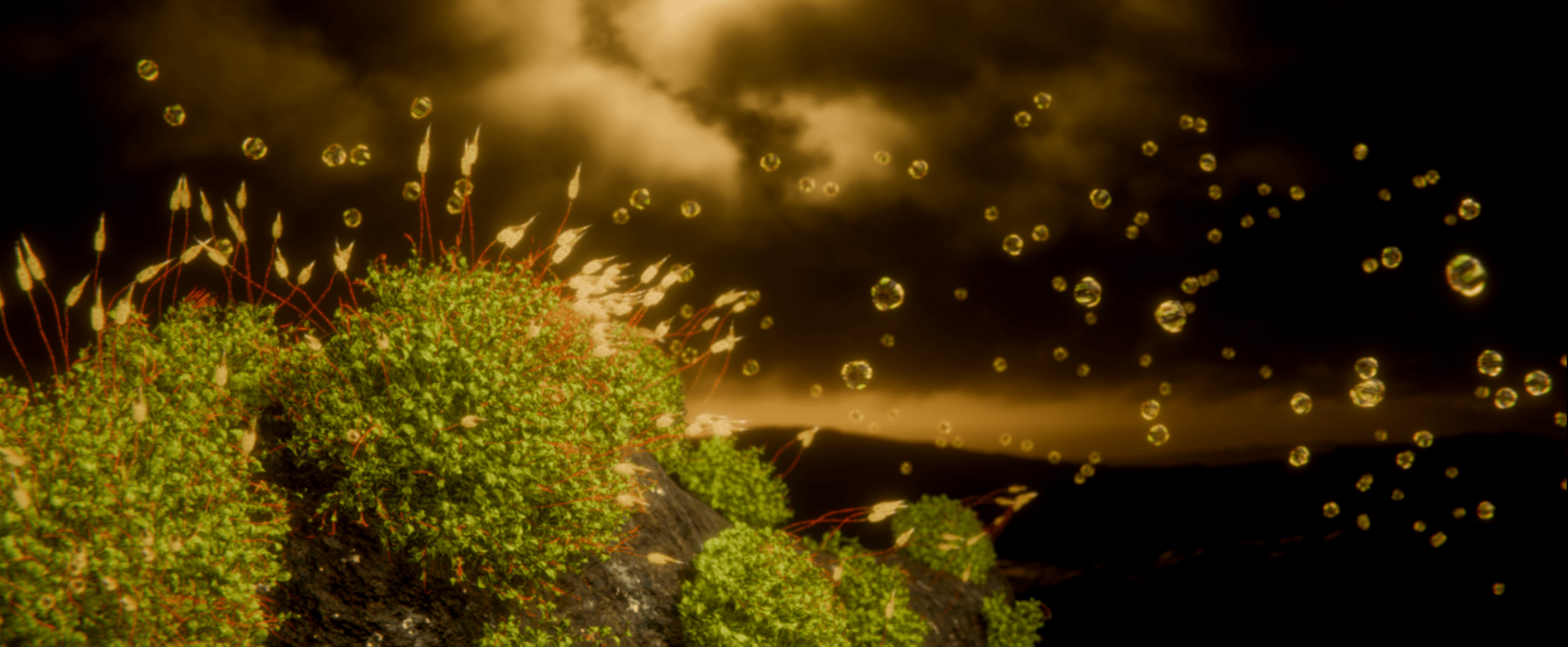
Boredomresearch is a collaboration between British artists Vicky Isley and Paul Smith. Their artworks combine biology and storytelling to examine the interconnected health of humans and the planet, addressing urgent environmental themes through poetic and imaginative means. They use 3D game, animation and film to present biological insights and creative ideas that encourage us to understand ourselves and the natural world from a different perspective.
We asked Boredomresearch some questions about their work and how they hope it will relate to us here in the New Forest…
Can you give us a brief overview of how your practice has developed and what led you to the work you produce today?
We began using computer simulation to explore life-like systems for their aesthetic beauty – this led us to appreciate the fragility of complex systems. Since then we have been working with scientists and conservation groups to explore ideas of health that connect humans to the more than human world.
Initially, what aspects of the New Forest do you envision influencing your work the most?
Despite being very old, the New Forest is constantly changing and evolving and therefore it remains true to its name ‘New’ but deeply connected to its past. We are interested in how the Forest has changed over time subject to different demands. It isn’t just a wild space, but a living landscape that’s been cared for, grazed, and protected over centuries. A landscape that is co-produced by people and non-human life. To contribute to this we will consider a collective memory of the Forest in the context of some current concerns and challenges – for example: At Denny Wood in the New Forest no saplings at all have survived since 1995. The Forest may seem permanent and unchanging but this is an illusion. We therefore ask what creativity is necessary to build strength and resilience for an unknown future.
We’re drawn to these layers of change – how the Forest has adapted to different pressures and continues to evolve. By listening to the stories held in its past and present, we hope to imagine possible futures. For us, the New Forest feels like a place of both strength and fragility, and that tension will be an important influence on our work.
How do you hope to engage the local community with your work?
We want to listen to people that work and live in the New Forest, that have an intimate connection with the Forest, that have seen changes over time. We are interested in collecting stories that are personal memories and stories of how people connect with the landscape and its diversity and how this is meaningful to them.
Are you planning to work in any new mediums during your residency?
During the residency, we’re planning on experimenting with alternative photographic processes.
How do you like to connect with nature and the great outdoors?
Nature has always been at the heart of our practice – it’s where our curiosity begins. When we’re not working in front of a screen, we’re happiest wandering outdoors, observing the quiet dramas of the natural world. Over the years, we have been lucky to work in some amazing otherworldly landscapes, from the vast peaks of the Rocky Mountains in Banff, Canada (2001) to the delicate miniature world of endangered moss in Powys, Wales (2024–25). Wherever we are, we find ourselves drawn to life forms that are often overlooked – organisms that barely move or are so tiny they require a lens to reveal them. Our projects have been inspired by intertidal snails clinging to rocks, marine micro-invertebrates adrift in seawater, the resilience of moss and even the humble limpet. This fascination finds its way into our bio-inspired fictional worlds, inviting audiences to share in the beauty of these often overlooked forms and fragile habitats.
What tools and materials will you be sure to pack for your studio space?
We like to bring the tools that allow us to observe and study nature – including hand lenses and microscopes as they allow us to see things that are invisible to the eye. Alongside these, we’ll pack our usual digital studio kit to capture visuals and audio in the natural environment.
To stay updated throughout Boredomresearch’s residency, follow us on social media and sign up to our e-newsletter.
You can also keep up to date with Boredomresearch via their website and Instagram:
Read more about the New Forest National Park Artist In Residence Programme here.