The New Forest is a haven for wildlife and home to a remarkable range of rare and fascinating species.
From bug-eating sundew plants and elusive pine martens to colourful damselflies and nationally scarce fungi, this ancient landscape supports a rich and varied ecosystem.
And thanks to the New Forest National Park Authority-led Species Survival Fund project, a coalition of five conservation partners is working to protect, restore, and expand habitats across the Forest.
These efforts intend to halt species decline while creating a brighter future for some of the Forest’s most special plants and animals.
The partners for the project are Amphibian and Reptile Conservation, Freshwater Habitats Trust, New Forest Commoners’ Defence Association, Hampshire and Isle of Wight Wildlife Trust and Wild New Forest.
The partners are supported by the RSPB and the New Forest Biodiversity Forum.
Surveys conducted by Wild New Forest help guide the work being undertaken by the partner organisations, ranging from planting hedgerows and seeding wildflower meadows, to creating ponds and clearing scrubland to maintain open heathland habitats.
Here are some of the fascinating and exciting discoveries uncovered at project sites around the fringes of the New Forest National Park.
Round-leaved Sundew

The New Forest is home to a variety of carnivorous plants that get some or most of their nutrients by trapping and digesting insects and other small invertebrates.
This is a round-leaved sundew, which has evolved to capture live prey, enabling it to survive in environments that are naturally low in nutrients.
The sticky sugary sap on the ends of the leaves is used to attract and trap unwary insects, which are then dissolved and absorbed by the plant.
Sundews are restricted to open, boggy habitats in the Forest and the project’s work to restore habitats will allow sundews and other threatened plant species to survive and thrive.
Pine Marten

Pine martens are elusive nocturnal mammals that have recently returned to the ancient woodlands of the New Forest.
Surprisingly, this one was captured in broad daylight.
The camera was recording mammal activity at a woodland site near the Forest edge, where conservation work funded through the project includes restoring and creating wetland and removing non-native rhododendron.
This work helps to increase species diversity and provides new high-quality habitat for native mammals like pine marten and otter.
Raft Spider

This striking image shows a female raft spider protecting her egg sac at a wetland site in the northern New Forest.
Raft spiders are nationally scarce but are relatively common in boggy habitats in the core of the Forest.
This female was one of several recorded during a wildlife survey around the edges of the National Park.
By restoring watery habitats, it is hoped the project will allow raft spiders and other threatened wetland species to spread their populations into the surrounding countryside.
Hampshire Purslane

A thriving colony of the nationally rare Hampshire purslane plant was found during a survey of a New Forest pond.
The New Forest is the only place in the UK where this aquatic plant is found in abundance, and its main threats here include a lack of suitable management and non-native invasive plant species.
The results from surveys such as this inform the project teams about the most appropriate ways to manage sites to support species and their habitats.
Small Red Damselfly

Small red damselfly is a nationally scarce species that is relatively widespread in the protected core of the New Forest thanks to lots of good-quality wetland habitats.
However, this one was found during a survey of a small wetland site on the Forest fringe that has suffered from historical drainage and is slowly being swamped by rhododendron plants which are taking over.
Restoring wetland habitats at this and other sites is an important part of the SSF project.
Meadow Grasshopper

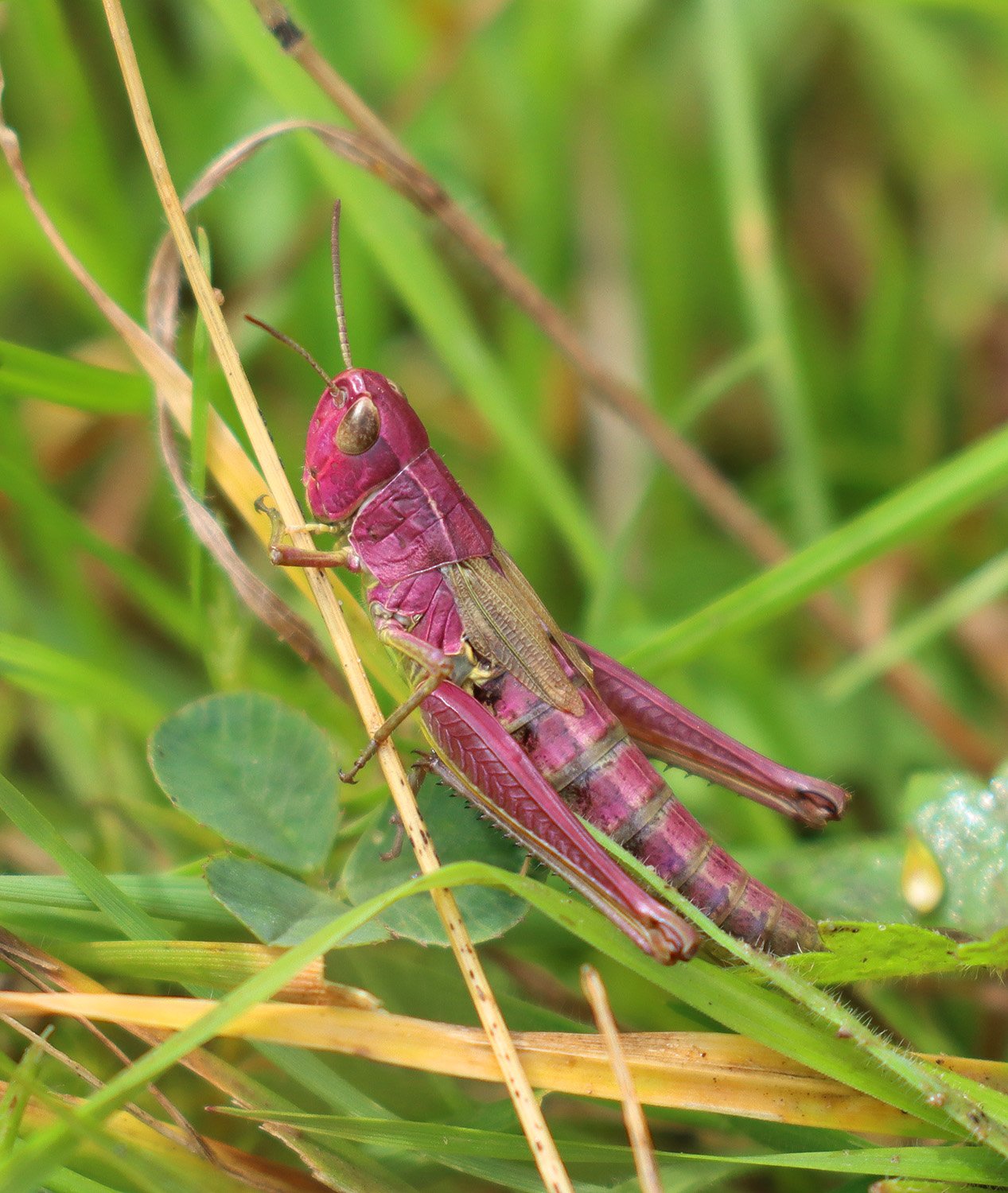
The rarely seen pink form of meadow grasshopper was another species spotted during survey work.
The pink colouration is caused by a genetic mutation called erythrism, which produces an excess of reddish pigment.
Wildflower-rich meadows, which are being created as part of the project, provide a haven for grasshoppers and other insects.
Blunthorn Nomad Bee

Grasslands around the fringes of the New Forest often contain wildflowers that are important sources of nectar for insects.
This nationally scarce Blunthorn nomad bee was found on a farm that is part of the project.
Wildflower meadows hugely benefit pollinating insects, including many that spend most of their lives on nearby protected habitats like heaths and ancient woodlands.
Stonechat

Stonechats are a familiar sight and sound on New Forest heathlands, with a call that sounds like two stones being struck together.
This photo was taken in farmland where new hedgerows and areas of rough grassland around fields have been created.
The increase in number of hedgerows and expansion of habitats will help birds like the stonechat increase their populations and distributions in and around the National Park.
Willow Emerald Damselfly

The New Forest is currently experiencing high turnover of mobile species such as winged insects and birds due to climate change, with many expanding or shifting their range northwards.
Dragonflies and damselflies are one group where species diversity has increased in recent years due to new arrivals making this region their home.
This willow emerald damselfly is a new arrival in the Forest and shows a preference for sunlit ponds with overhanging willows.
This one was photographed during a survey of a pond. The survey team use this data to adapt the plan for the site to ensure new ‘climate colonists’ like willow emerald damselfly can consolidate and increase their populations.
Drumstick Truffleclub

The wonderfully named drumstick truffleclub is a fungus that is connected underground to a subterranean fungus called a false truffle.
This example was found in woodland during a survey.
Drumstick truffleclubs are nationally rather scarce, and form part of a group of nearly 3,000 fungi species in the New Forest that is internationally important.
The survey results enable the project team and the landowner to plan future conservation work in a way that avoids damaging the soil structure and the associated fungi at this site, while increasing overall species diversity.
This project is funded by the Government’s Species Survival Fund. The fund was developed by Defra and its Arm’s-Length Bodies. It is being delivered by The National Lottery Heritage Fund in partnership with Natural England and the Environment Agency.